
“Customers don’t usually tell you they’re leaving. They just stop showing up.”
I’ve seen this across growing businesses where traffic and sign-ups look healthy, but retention quietly slips. Customer retention software starts to matter when you realize churn is often about missed moments, not broken products.
Most customers leave because something felt unclear or unattended. A question that didn’t get answered. A follow-up that never happened. A small gap in the experience that made it easier to move on.
Retention is really about staying helpful after the initial ‘yes’. And doing that consistently without exhausting your team is tough without the right tools. In this guide, I’ve compiled the 9 best customer retention tool options that help reduce churn, keep customers engaged, and convert early interest into long-term loyalty.
Why Customer Retention Matters
Customer retention matters because sustainable growth depends on keeping the customers you already worked hard to acquire. While new sign-ups may look promising, long-term revenue is driven by customers who stay, engage, and continue to see value. When retention is weak, businesses are forced to spend more on acquisition just to maintain the same growth level.
In most cases, customers leave due to experience gaps rather than product issues. Missed follow-ups, slow responses, or a lack of guidance often push them away quietly.
Here’s why retention deserves serious attention:
- Retaining customers is more cost-effective than constant acquisition.
- Repeat customers are more likely to purchase again and explore higher-value offerings.
- Strong retention improves customer lifetime value and revenue stability.
- Engaged customers are easier to support and more likely to advocate for your brand.
- Predictable retention reduces pressure on marketing and sales teams.
When retention improves, growth becomes steadier, more efficient, and easier to scale over time.
List of 9 Best Customer Retention Software
This list includes a detailed comparison of the nine best tools, based on hands-on experience and recommendations from trusted peers. I also reviewed customer feedback on leading review platforms to better understand how these tools perform in real-world use as churn management software.
Before we explore each option, here’s a quick comparison of the top customer retention software.
| Customer Retention Software | Best for | Pricing | User Rating |
|---|---|---|---|
| ProProfs Chat | Easy Live Chat & AI Customer Service Agent for Instant, Automated Support | Free plan available. Paid starts at $19.99/user/month | 4.8 (Capterra) |
| ProProfs Help Desk | AI-assisted help desk for accurate and fast customer support | Free plan available. Paid starts at $19.99/user/month | 4.9 (Capterra) |
| Heap | User behavior and retention analysis | Custom pricing | 4.4 (G2) |
| Qualaroo | AI-powered sentiment analysis and targeted feedback | Free plan available. Paid starts at $19.99/month | 4.7 (Capterra) |
| Optimizely | Web and product experimentation to improve retention | Custom pricing | 4.2 (G2) |
| Mambo.io | Enterprise gamification for engagement-driven retention | Custom pricing | 4.6 (G2) |
| BIGContacts | Contact management and email-based retention | Free plan available. Paid starts at $9.99/month | 4.3 (G2) |
| Yotpo | eCommerce retention marketing through loyalty and reviews | Starts at $79/month | 4.3 (G2) |
| Mailchimp | Email marketing for ongoing customer engagement | Starts at $13/month | 4.5 (Capterra) |
1. ProProfs Chat – Best for Easy Live Chat & AI Customer Service Agent for Instant, Automated Support
I’ve seen how quickly customers lose interest when their questions go unanswered. That’s why ProProfs Chat works so well as a customer retention tool. It helps businesses stay available around the clock, making sure customers always feel heard, even outside business hours.
I also like how easy it is to get started. Just by entering your website URL, ProProfs Chat can create an AI customer support agent using your existing website content, so you can start assisting customers without spending hours on setup.
For businesses that want to explore these capabilities further, its AI Support Agent offers much more than automated replies. Advanced AI agent training trains the chatbot on your website, help center, and FAQs, so AI-generated answers always pull from your actual data with the source cited. Once live, action-based AI agents complete tasks like updating orders and scheduling meetings directly from chat.
Sentiment analysis detects emotions in real time and feeds into risk prediction, which assigns churn scores so your team knows who needs attention. Resolution overviews and AI agent performance reports, then continuously track satisfaction.
Plus, it keeps conversations smooth and organized. Real-time visitor tracking, smart routing, canned responses, and detailed transcripts enable teams to respond faster and follow up more effectively. It also integrates seamlessly with ProProfs Knowledge Base and ProProfs Help Desk, helping you deliver a more connected self-service and live support experience from a single ecosystem. When combined with other ProProfs tools, it creates a consistent experience that keeps customers engaged instead of drifting away.
Pros:
- Action-based AI agents that update orders, schedule meetings, and trigger notifications
- Sentiment analysis and risk prediction to flag frustrated or at-risk customers early
- Resolution overviews and AI performance reports to track and improve chatbot quality continuously
- Canned responses help answer frequently asked questions promptly.
- Proactive chat invitations to boost engagement and reduce bounce rates
Cons:
- Cloud-only access with no offline mode
- No dark theme option
User Rating: 4.8 (Capterra)
Pricing: A free plan is available for growing teams. Paid plan starts at $19.99/user/month.
2. ProProfs Help Desk – Best for AI-Assisted Help Desk for Customer Delight
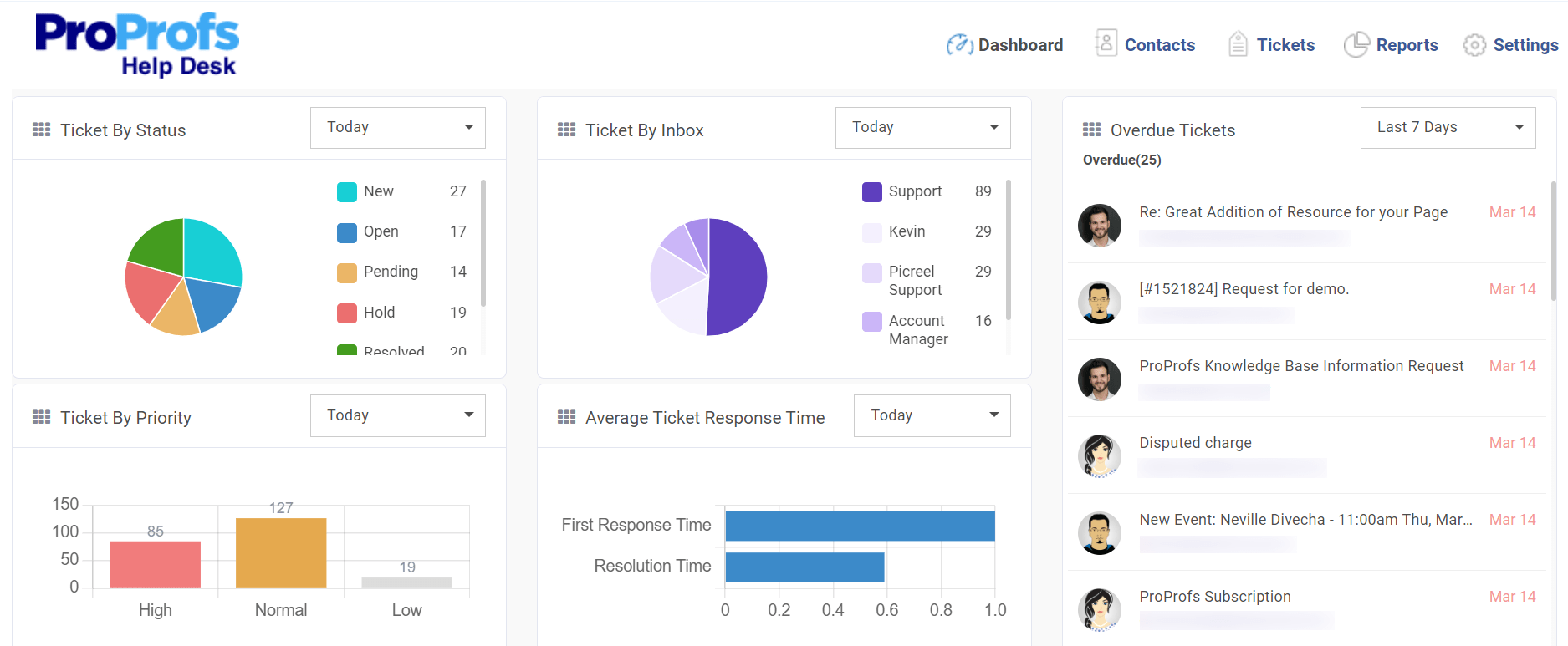
I’ve worked with enough support tools to know that fast replies mean very little if they are not accurate. That’s where ProProfs Help Desk has consistently impressed me. It’s built to help teams respond quickly while still keeping responses clear, relevant, and human, which plays a big role in customer retention.
The AI help desk features actually feel practical. Ticket summarization and response suggestions save my team a lot of time, especially when dealing with long or unclear customer queries. The AI quickly breaks things down, recommends accurate replies, and helps maintain a consistent tone, so conversations feel polished instead of rushed.
What I like most is how structured everything feels. All customer conversations flow into one shared inbox, making it easy to stay organized. Internal notes support collaboration, the knowledge base reduces repeat questions, and surveys and reports help track service quality and retention.
Pros:
- AI-powered ticket assistance to summarize requests and suggest accurate responses
- Shared omnichannel inbox to manage all customer conversations in one place
- Mobile apps for Android and iOS to support customers on the go
- Customer Delight Suite integration to deliver 360-degree customer support
Cons:
- Cloud-only platform with no offline access
- No dark theme option
User Rating: 4.9 (Capterra)
Pricing: A free plan is available for growing teams. Paid plans start at $19.99 per user per month.
3. Heap – Best for User Behavior Analysis
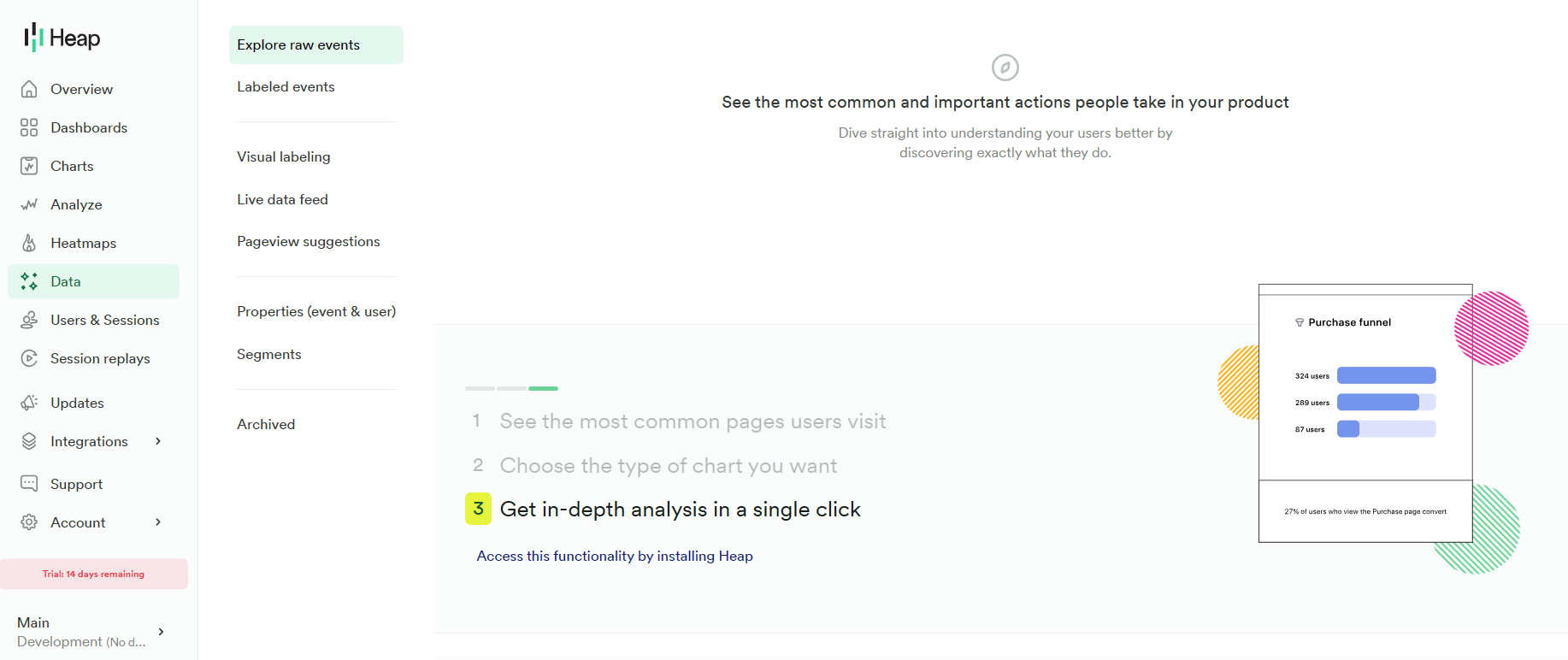
I see Heap as a solid option when the focus is on understanding how users actually interact with a product. It automatically captures every click, page view, and interaction, which removes the need for manual event tracking and reduces setup time. That makes it easier to start analyzing retention issues without technical delays.
What I like about Heap is how clearly it links user behavior to retention outcomes. You can follow real user journeys, see where drop-offs happen, and compare patterns between retained and churned users. This level of detail is especially useful when improving onboarding, feature adoption, or overall product experience.
Heap also works well for teams that want insights without spending weeks configuring reports. The interface is straightforward, and the visualizations help teams move from data to action quickly.
Pros:
- Automatic event capture to track every user interaction without manual setup
- Funnel and journey analysis to identify drop-off points affecting retention
- Cohort analysis to compare behavior of retained versus churned users
- Visual dashboards and reports to support faster decision-making across teams
Cons:
- Can feel overwhelming for teams new to analytics
- Pricing may be high for small or early-stage teams
User Rating: 4.4 (G2)
Pricing: Customer Pricing.
4. Qualaroo – Best for AI-Powered Sentiment Analysis
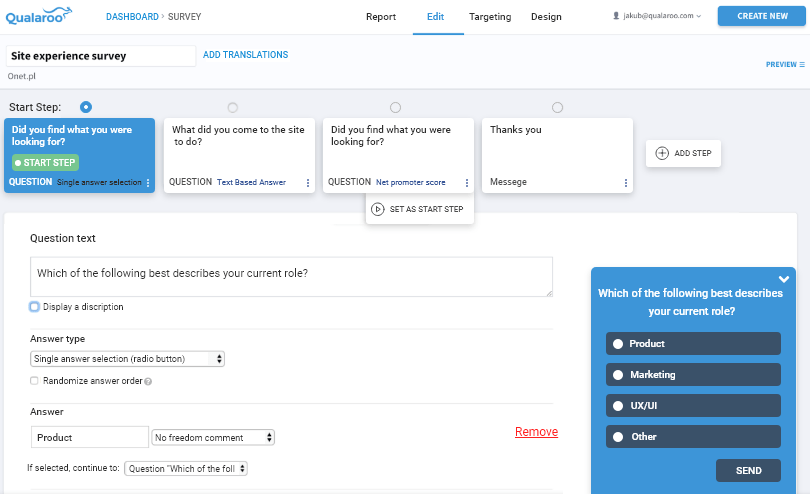
Qualaroo is one of those tools that earns its place in a retention stack because it helps you understand what customers are actually feeling, not just what they’re clicking. I’ve used it extensively to uncover why users drop off, hesitate, or stay engaged, and the AI-powered sentiment analysis is what truly sets it apart. It quickly turns open-text feedback into clear insights, saving hours of manual analysis.
The Nudge™ surveys are another reason Qualaroo works so well for retention. They appear right when users are interacting with your product, website, or app, without feeling intrusive. You can target very specific segments, like users who failed onboarding, paying customers, or visitors from a particular campaign, which makes the feedback far more actionable.
What I appreciate most is how thoughtfully the tool is designed for fast-moving teams. Smart branching keeps surveys short and relevant, while multilingual and in-app support ensures you’re collecting feedback across every touchpoint. For teams focused on reducing churn, Qualaroo helps replace guesswork with data you can act on quickly.
Pros:
- AI-powered sentiment analysis to instantly understand themes and emotions in open-ended feedback
- Advanced targeting and segmentation to reach users based on behavior, lifecycle stage, and context
- Nudge™ surveys across web, app, and prototypes to capture feedback at the moment of interaction
- Branching and skip logic to keep surveys focused and user-friendly
Cons:
- Dedicated onboarding and account management are mainly available on paid plans
- No on-premise or offline version
User Rating: 4.7 (Capterra)
Pricing: Free plan available with all premium features. Paid starts at $19.99 per month, followed by Business at $49.99 and Enterprise at $149.99.
5. Optimizely – Best for Web Experimentation

Optimizely works well when retention depends on improving how users experience your website or product. I think of it less as a direct engagement tool and more as a way to remove friction that causes customers to leave. It helps teams test what actually works instead of relying on assumptions.
What I like about Optimizely is how structured experimentation becomes part of everyday decision-making. You can test onboarding flows, landing pages, CTAs, and pricing layouts to see what keeps users moving forward. These improvements may feel small, but they add up and have a real impact on retention over time.
For teams focused on product-led growth or conversion-driven retention, Optimizely fits naturally. It does not talk to customers for you, but it helps you build experiences that make customers want to stay.
Pros:
- A/B and multivariate testing to validate which experiences improve engagement and reduce drop-offs
- Audience segmentation to deliver experiments tailored to specific user behaviors and segments
- Visual experimentation editor to launch tests without relying heavily on engineering teams
- Experiment analytics and insights to measure how changes affect retention-related metrics
Cons:
- Requires time and experimentation discipline to see results
- Not designed for direct customer communication like chat or messaging tools
User Rating: 4.2 (G2)
Pricing: Custom Pricing.
6. Mambo.io – Best for Enterprise Gamification
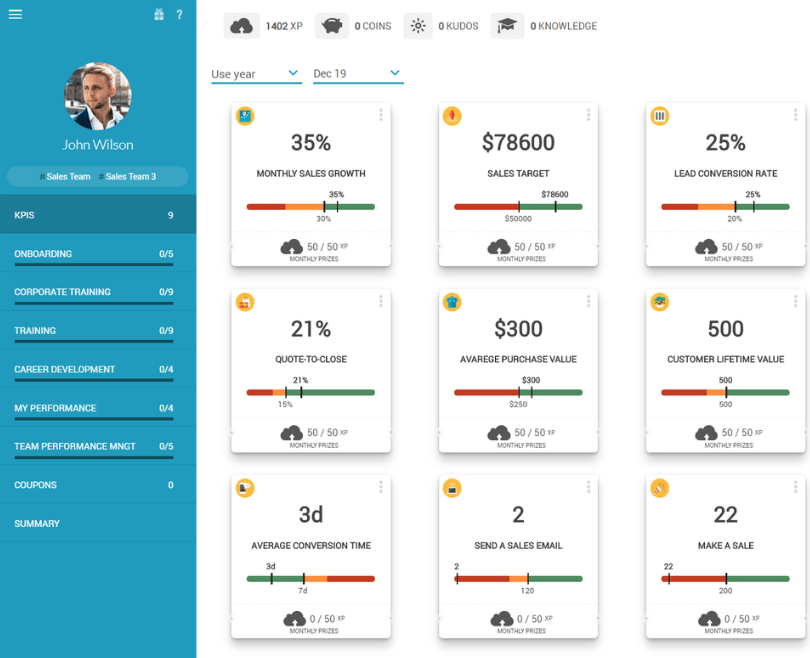
Mambo.io is a strong fit if retention for you is all about engagement and motivation at scale. Instead of focusing on conversations or support workflows, it uses gamification to keep customers active, involved, and coming back. I see it working especially well for enterprise teams that want to influence behavior over time, not just react when customers are about to leave.
What stands out to me is how flexible the platform is. You can design your own points, badges, challenges, and rewards around the actions that matter most to your business. Whether that’s repeat usage, training completion, or loyalty actions, Mambo.io turns those moments into something customers actually want to participate in. It feels less like retention software and more like a long-term engagement layer.
That said, this is clearly built with larger teams in mind. There’s a learning curve, and it works best when you already have a defined retention or loyalty strategy. If gamification is central to how you keep customers engaged, Mambo.io gives you the depth to do it well.
Pros:
- Customizable gamification engine to create points, badges, and missions that reward meaningful customer actions
- Behavior-based tracking and analytics to understand what drives engagement and repeat usage
- Leaderboards and challenges to encourage ongoing participation and healthy competition
- Enterprise-grade APIs and integrations to embed gamification into existing products and platforms
Cons:
- Setup can feel complex without technical or product support
- Better suited for enterprise teams than small businesses
- Does not focus on real-time conversations or support-driven retention
User Rating: 4.6 (G2)
Pricing: Custom pricing
7. BIGContacts – Best for Contact Management & Email Marketing
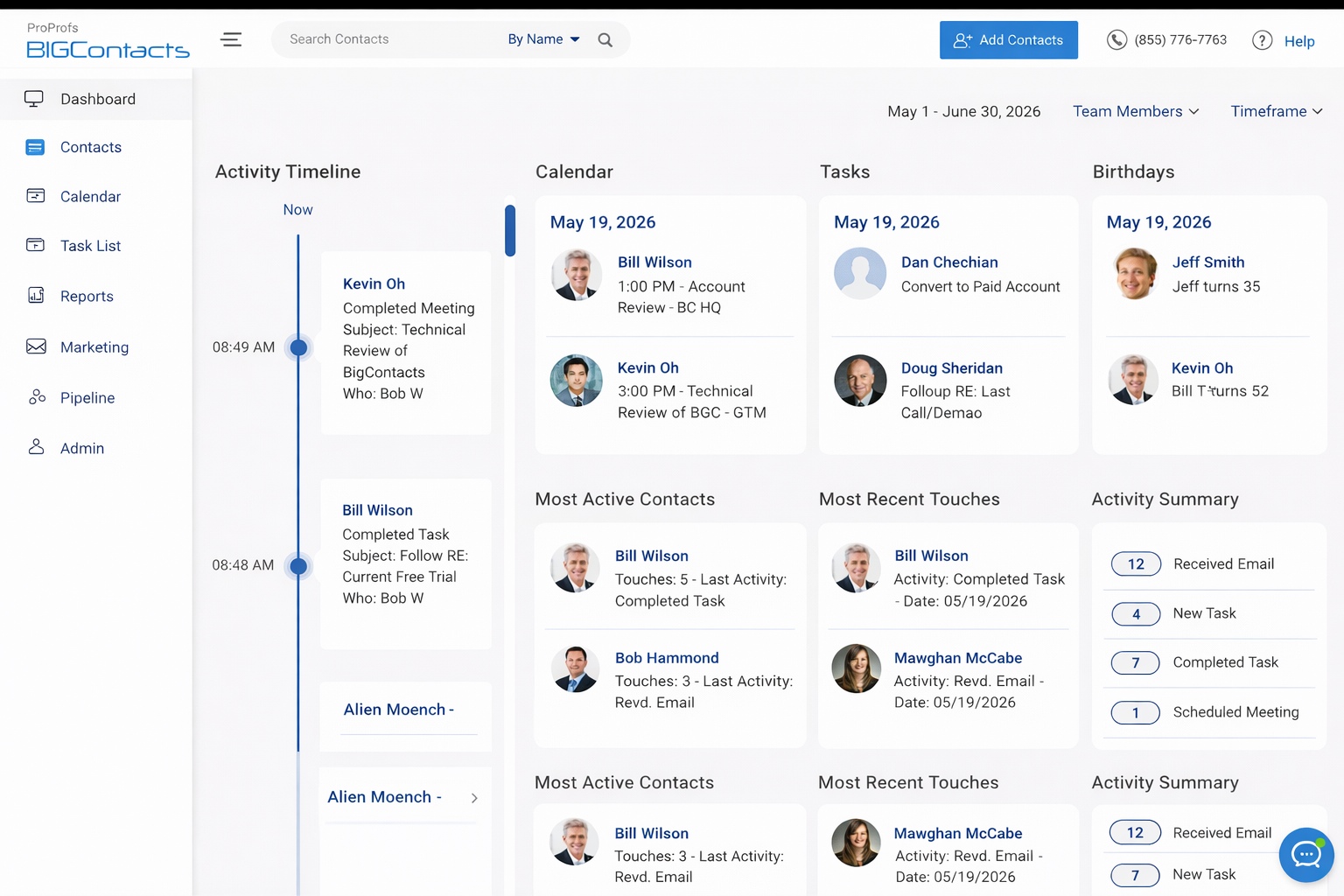
BIGContacts earns its place on this list because it focuses on something retention depends on most: strong, consistent relationships. Instead of spreading customer data across tools, it pulls emails, notes, tasks, and interactions into one clean dashboard. That 360° customer view makes it much easier to follow up with context and keep conversations moving forward.
One feature that significantly enhances retention is the visual sales pipeline. I appreciate being able to drag and drop deals across stages and instantly identify which relationships require attention. When customers stall or go quiet, it’s obvious, which helps prevent missed follow-ups that often lead to churn.
Plus, BIGContacts makes long-term engagement quite easy with its simple email automation. Drip campaigns, follow-ups, and engagement tracking help you stay in touch without being repetitive, while task reminders keep customer relationships on track.
Pros:
- 360° contact view for keeping every interaction, email, and task in one place
- Visual drag-and-drop pipeline to track relationships and spot stalled deals early
- Email automation and drip campaigns to maintain consistent engagement over time
- Customization and segmentation tools for more personalized retention efforts
- Built-in task management and reminders to ensure follow-ups never slip
Cons:
- No downloadable or on-premise version available
- Dark mode interface is not currently supported
User Rating: 4.3 (G2)
Pricing: Forever free for small teams. Paid starts at $9.99/month.
8. Yotpo – Best for eCommerce Retention Marketing
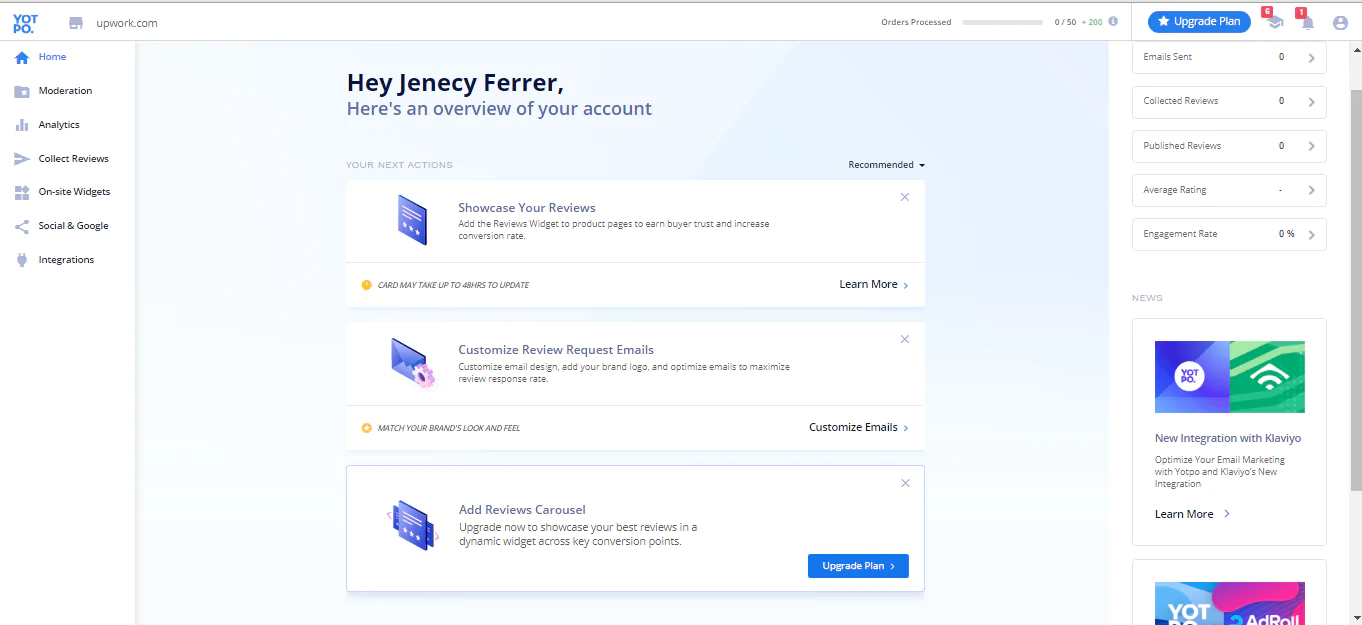
Yotpo feels like a platform built for brands that take retention seriously, not as a side tactic but as a core growth lever. In my experience, it works best for eCommerce teams that want to move beyond one-off campaigns and build long-term relationships through loyalty, reviews, and repeat engagement.
What stood out to me is how Yotpo connects customer feedback with retention marketing. Reviews, ratings, and user-generated content are not just there for credibility. They actively feed into how customers discover products, feel confident about purchases, and come back for more.
As a retention tool, Yotpo shines when scale and personalization matter. I’ve seen it work well for brands that want to segment customers based on behavior, reward loyalty meaningfully, and stay in touch through SMS and email without feeling spammy. It’s not lightweight, but it’s powerful when used intentionally.
Pros:
- Loyalty and rewards programs to drive repeat purchases and long-term customer engagement
- Reviews and user-generated content to build trust and influence buying decisions
- SMS and email retention campaigns to re-engage customers based on real shopping behavior
- Referral marketing tools to turn happy customers into repeat buyers and advocates
Cons:
- Pricing can be high for small or early-stage eCommerce stores
- Initial setup requires time due to the breadth of features
- Some advanced analytics and customization are locked behind higher tiers
User Rating: 4.3 (G2)
Pricing: Starts at $79/month.
9. Mailchimp – Best for Email Marketing
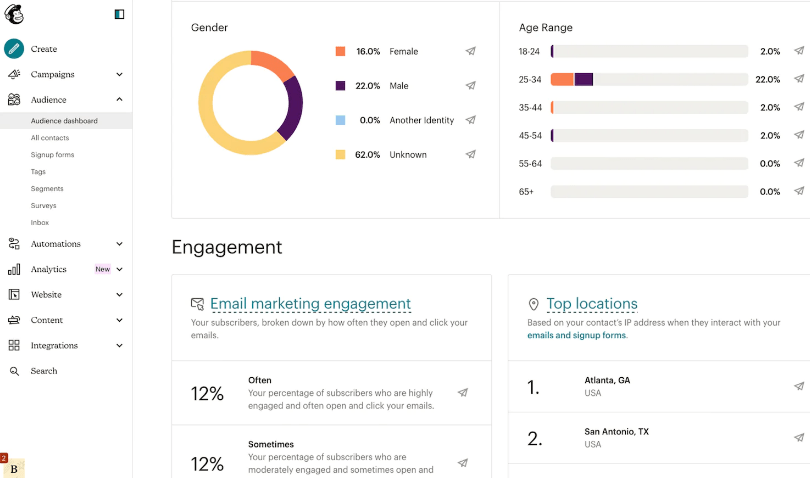
I’ve always seen Mailchimp as the easiest way to stay in touch with customers without overcomplicating things. It started as an email marketing tool, but over time, it has grown into a solid retention platform for businesses that rely on ongoing communication to keep customers engaged.
What works well for retention is how Mailchimp helps you send the right email message at the right time. You can segment audiences based on behavior, purchases, or engagement, and follow up with content that feels genuinely relevant. Instead of blasting the same email to everyone, it lets you build more thoughtful customer journeys.
I also like how approachable the platform feels. You don’t need a dedicated marketing team to use it effectively. Between templates, automation, and clear reporting, Mailchimp makes it easier to keep customers informed, engaged, and coming back without adding much operational overhead.
Pros:
- Audience segmentation for targeted messaging to send relevant emails based on behavior and preferences
- Automated email journeys to nurture customers with timely follow-ups and re-engagement campaigns
- Email templates and a drag-and-drop builder to create professional emails without design help
- Campaign analytics and reporting to track opens, clicks, and engagement trends over time
Cons:
- Limited flexibility outside of email-centric retention strategies
- Advanced automation features require higher-tier plans
User Rating: 4.5 (Capterra)
Pricing: Starts from $13/month.
Customer Retention Software: My Top 3 Picks
With so many great tools available, the right choice comes down to your priorities. These are the top three I found most effective
1. ProProfs Chat
ProProfs Chat supports customer retention by enabling round-the-clock support through AI chatbots. It offers quick setup with ready-made templates, accurate responses through AI training, and organized conversations using visitor tracking, routing, and transcripts. Together, these features help teams respond faster, stay consistent, and keep customers engaged.
2. Mailchimp
Mailchimp supports customer retention by enabling timely, relevant email communication. Businesses can segment audiences, automate follow-ups, and personalize messaging based on customer behavior and engagement. With simple templates, automation tools, and straightforward reporting, it helps teams maintain ongoing customer relationships without adding operational complexity.
3. BIGContacts
BIGContacts supports customer retention by centralizing emails, notes, tasks, and interactions in one dashboard. Its visual sales pipeline helps teams track relationships and spot stalled deals early. Email automation, follow-ups, engagement tracking, and task reminders make it easier to maintain consistent communication and reduce missed opportunities.
What to Look for in Customer Retention Software: A Quick Checklist
Not all customer retention management software is built the same. The right choice depends on how well it fits your business model, team size, and customer journey. Before committing to a tool, it helps to focus on the essentials that actually impact retention, not just feature lists.
Use this quick checklist to evaluate your options:
| What to Look For | Why It Matters | What to Check |
|---|---|---|
| Ease of setup and use | Speeds up adoption across teams | Minimal setup, intuitive UI, low training effort |
| AI and automation | Reduces response time and support workload | AI bots or automated flows that handle common queries reliably |
| Lead and customer data capture | Enables follow-ups and personalization | Automatic capture of contact details and conversation history |
| CRM and tool integrations | Keeps data centralized and usable | Native or easy integrations with CRM and marketing tools |
| Omnichannel engagement | Customers interact across multiple touchpoints | Support for chat, email, social, and in-app communication |
| Customization and branding | Maintains a consistent customer experience | Ability to customize widget, messaging, and appearance |
| Analytics and reporting | Helps identify churn risks | Clear reports on engagement, responses, and customer behavior |
| Scalability and pricing flexibility | Supports long-term growth | Transparent pricing that scales with usage and team size |
FREE. All Features. FOREVER!
Try our Forever FREE account with all premium features!
Reduce Churn and Build Customer Loyalty That Lasts!
Customer retention is no longer a nice-to-have. It plays a direct role in how stable and scalable your business becomes over time. The right client retention software can help you stay connected with customers when it matters most.
When choosing customer retention software, focus on tools that fit your workflow, not just feature lists. Look for simple setup, reliable automation, and clear visibility into customer conversations. Prioritize solutions that help you respond faster, capture intent, and follow up without adding complexity for your team.
If you’re looking for a practical, easy-to-use option, ProProfs Chat is worth considering. It helps you engage visitors in real time, automate common conversations, and keep support human when it matters.
Try it today and see how it can help you turn more conversations into long-term customers!
FREE. All Features. FOREVER!
Try our Forever FREE account with all premium features!

 We'd love your feedback!
What did you like & how can we make it even better?

 Thanks for your feedback!
 Ask Your Question
Have a question? Get expert help to make your decision easier.