
Your best salesperson never sleeps, never asks for a raise, and closes deals at 2 AM without complaining. It’s not a superstar hire; it’s an AI sales chatbot, and businesses that deploy one well are quietly outselling those that don’t.
The math is simple. A lead hits your pricing page at 11:52 PM. They have one question. Your team signed off at 6. That visitor waits, hears nothing, and buys from a competitor who had an AI agent ready to respond in seconds. That scenario plays out thousands of times a day for businesses still running on business-hours-only support.
I’ve spent months testing these platforms across real sales and support environments. The difference between a mediocre bot and a great one shows up quickly: missed handoffs, clunky integrations, and agents that frustrate visitors rather than convert them.
This guide covers the 12 best AI sales chatbots, based on months of hands-on testing across real sales and support environments.
What Is an AI Sales Chatbot?
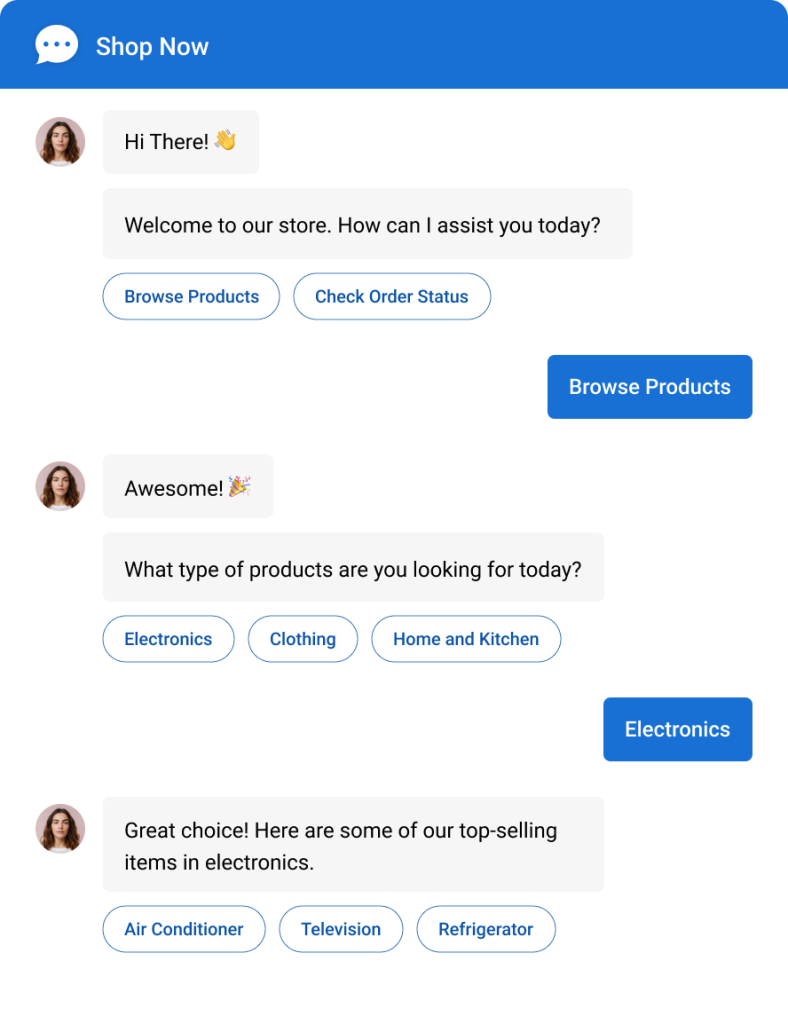
Where traditional bots collapsed the moment a visitor went off-script, AI sales chatbots read intent. They pull answers from your website, help docs, uploaded files, and FAQs, and they get smarter with every conversation. The best ones go further than just answering questions.
They book meetings, update orders in Shopify, push qualified leads into Salesforce, detect when a customer is frustrated, and hand the conversation to a human agent before things go sideways.
That shift is already underway at scale. According to McKinsey’s 2025 State of AI report, 71% of companies now use generative AI in at least one business function, up from 65% in early 2024.
Here’s what puts these tools in a league of their own:
- Trains on your website, help docs, FAQs, and uploaded files for accurate, brand-consistent answers
- Qualifies leads with dynamic, branching question flows
- Provides 24/7 coverage without adding headcount
- Detects customer sentiment in real time and escalates when needed
- Integrates with CRM, help desk, scheduling, and eCommerce platforms
- Deploys across website chat, WhatsApp, Facebook, Instagram, and SMS
Top 12 AI Sales Chatbots to Deliver Instant Support
I evaluated these AI chatbots for sales through hands-on testing, verified user reviews on G2, Capterra, and Gartner, and input from peers who run support and sales operations daily.
Here’s the full comparison before the details:
| AI Sales Chatbot | Best For | Pricing | User Rating |
| ProProfs Chat | Easy Live Chat & AI Customer Service Agent for Instant, Automated Support | A free plan is available for growing teams. Paid plan starts at $19.99/user/month. | 4.8/5 (Capterra) |
| Intercom | SaaS teams with complex support workflows | From $29/seat/month + $0.99/AI resolution | 4.5/5 (G2) |
| Tidio | eCommerce sales automation | Free plan available. AI from $42/month | 4.7/5 (Capterra) |
| Chatbase | Lead Capture and Closure in the Conversation | Free plan available; paid plans start at $32/month | 4.8/5 (G2) |
| Zendesk AI | Enterprise teams on the Zendesk stack | From $55/agent/month | 4.3/5 (G2) |
| Freshdesk Freddy AI | Mid-market support and ITSM | From $15/agent/month. AI from $29/agent/month | 4.4/5 (G2) |
| Drift | B2B pipeline acceleration | Custom pricing, typically from $2,500/month | 4.4/5 (G2) |
| Ada | Enterprise-scale automation | Custom pricing | 4.6/5 (G2) |
| HubSpot Chatbot | Conversational lead generation | From $15/seat/month | 4.4/5 (G2) |
| Crisp | Engaging dialogues for growing teams | From $95/month | 4.5/5 (G2) |
| Chatfuel | Facebook Messenger automation | From $12.04/month | 4.3/5 (Capterra) |
| Kommunicate | Mobile-first in-app AI support | From $40/month | 4.5/5 (G2) |
1. ProProfs Chat – Best for Easy Live Chat & AI Customer Service Agent for Instant, Automated Support
I started testing ProProfs Chat when our team needed 24/7 lead coverage without expanding headcount. What surprised me was how fast the AI customer support agent became genuinely useful, not after six weeks of training, but within a single day.
All I had to do was enter our website URL, and it generated an AI agent using our existing content. You can try it here:
From there, I expanded its knowledge with FAQs, help articles, and uploaded files as our support library grew. You point it at your website URL or upload your help articles, and it starts handling FAQs, qualifying leads, and booking appointments with no coding required.
The sentiment analysis engine reads every message in real time and flags whether a customer is angry, confused, or confident, so your team knows exactly when to step in. The risk prediction feature assigns a churn score (High, Medium, or Low) to every conversation, giving sales and success teams a live view of who needs urgent attention.
The action-based AI agents go beyond answering questions; they complete tasks mid-conversation like updating Shopify orders, scheduling meetings, or sending Slack notifications. An AI-generated resolution summary is auto-created at the end of every chat, so nothing falls through the cracks. It also integrates seamlessly with ProProfs Knowledge Base and ProProfs Help Desk, making it easy to combine AI conversations, self-service resources, and human support in a single workflow.
Pros:
- Advanced AI agent training on website URLs, uploaded files, FAQs, and help center articles
- Sentiment analysis and churn risk scoring built into every conversation
- Action-based AI customer support agents that complete tasks like Shopify updates, meeting scheduling, and Slack notifications
- AI-generated resolution summaries auto-created at the end of every chat
- Forever Free plan with all premium features for single operators
Cons:
- Cloud-only; no offline access
- No dark theme in the chat widget
User Rating: 4.8/5 (Capterra)
Pricing: A free plan is available for growing teams. Paid plan starts at $19.99/user/month.
See how Horse Saddle Shop used ProProfs Chat to deliver 24/7 multilingual support without adding headcount.

2. Intercom – Best for SaaS Teams With Complex Support Workflows
Intercom’s AI agent, Fin, is built on large language models and pulls answers directly from your existing help content. It handles multi-step conversations better than most tools in this category and integrates deeply into Intercom’s broader CX platform. Ticketing, customer data, and proactive messaging are all accessible from one place.
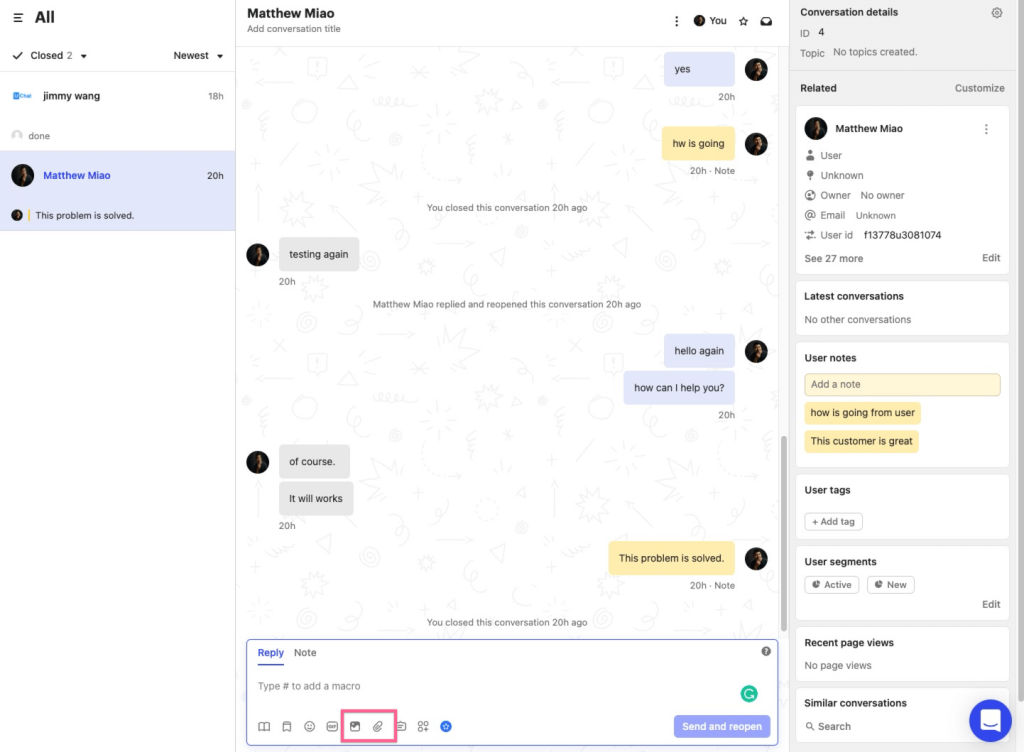
For SaaS companies with rich help centers, Fin reduces tier-1 volume significantly without requiring manual flow-building. The resolution rate tracking is detailed enough to show exactly what the agent is and is not earning its keep on. Behavioral triggers and proactive messaging let you reach customers before they even ask.
The tradeoff is cost. Intercom’s pricing scales quickly with seat count and usage, and the per-resolution fee on Fin catches many teams off guard at growth stage. It is a strong choice for teams with the budget, but smaller operations will find better value elsewhere on this list.
Pros:
- Fin AI is context-aware and handles multi-turn conversations reliably
- Deep integration with Intercom’s inbox, ticketing, and CRM
- Detailed resolution rate tracking and reporting
- Proactive messaging and behavioral triggers to engage customers before they ask
- Omnichannel coverage across chat, email, and messaging apps in one platform
Cons:
- Pricing is high and accelerates quickly at scale
- More infrastructure than small teams strictly need for AI chat
User Rating: 4.5/5 (G2)
Pricing: Starts at $29/seat/month. Fin AI billed separately at $0.99 per resolved conversation.
3. Tidio – Best for eCommerce Support and Sales Automation
Tidio combines live chat and an AI agent called Lyro in a single platform built specifically around eCommerce workflows. Lyro handles support queries using your FAQ content, while the Flows builder lets you create lead capture and cart recovery sequences without writing a line of code. The interface is clean and setup friction is minimal.
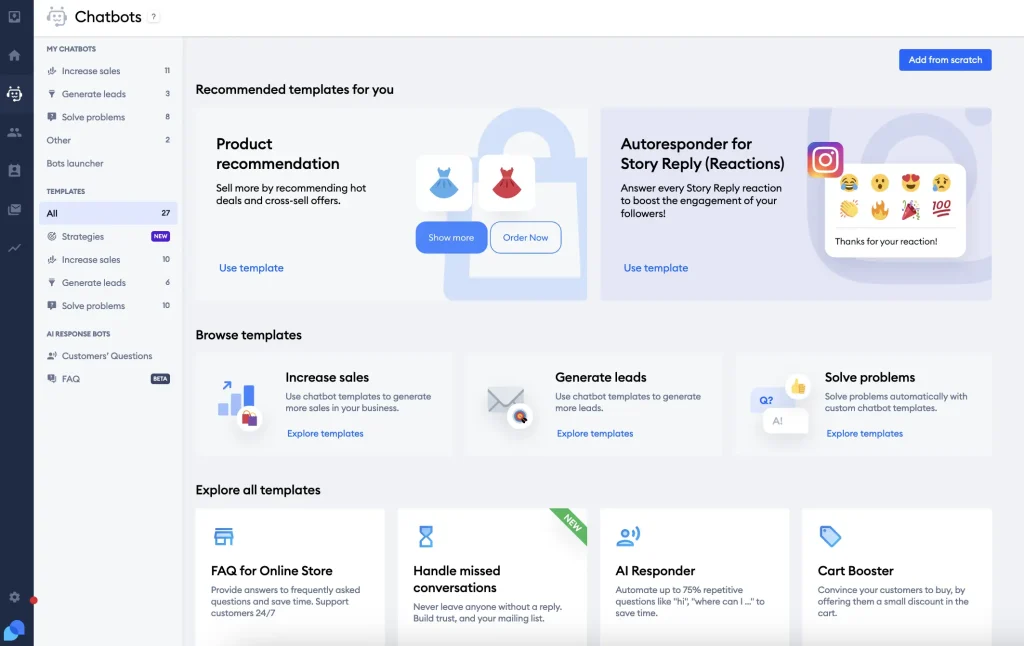
For Shopify and WooCommerce setups, Tidio pulls order details, recommends products, and triggers post-purchase follow-ups automatically. Native integrations with Magento are also available, making it one of the more complete solutions for stores running on popular eCommerce platforms. It covers both support and sales in a single tool, which reduces the need for stitching multiple products together.
The main limitation is cost at volume. Lyro has a conversation cap on lower plans, and the price scales up fast as your chat traffic grows. Teams outside of eCommerce will also find Tidio less tailored to their use case compared to more generalist platforms.
Pros:
- Lyro AI answers support questions directly from FAQ content
- Native Shopify, WooCommerce, and Magento integrations
- eCommerce-specific flows for cart abandonment and product recommendations
- Clean interface with minimal setup friction
- Free plan available to get started without any upfront cost
Cons:
- Lyro has a conversation cap on lower plans; cost scales fast with volume
- Less suited for non-eCommerce use cases
User Rating: 4.7/5 (Capterra)
Pricing: Free plan available. Lyro AI from $42/month (50 conversations).
4. Chatbase – Best for Lead Capture and Closure in the Conversation
I found Chatbase especially useful for teams that want to move beyond simply capturing leads and actually take action within the same conversation. Its AI agent can qualify prospects, answer product questions using approved business data, and book a meeting via Calendly or Cal.com, or create an order directly from WhatsApp or Instagram via the Shopify integration.
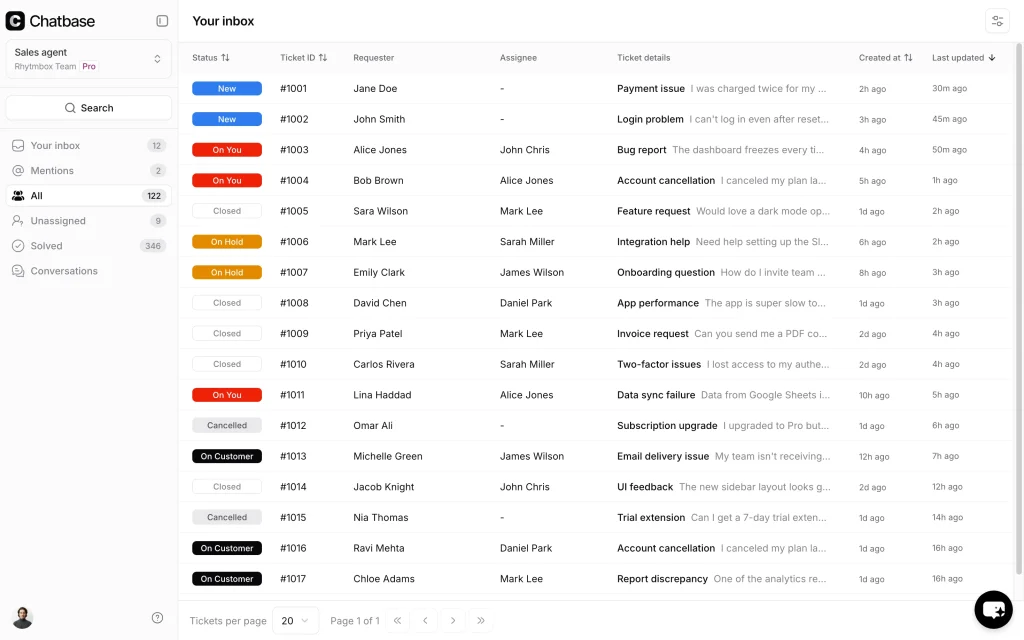
What made this stand out for me is the Actions capability. Instead of collecting a lead’s info and waiting for a human to follow up, the agent pulls live data from Salesforce, Stripe, or a custom API and acts on it.
A returning customer asking about an upgrade gets a real answer with their account context, not a form to fill out. Teams define these workflows (Chatbase calls them Procedures) in plain language, no code involved, so sales ops can set the logic without engineering.
The agent deploys across chat, email, WhatsApp, Messenger, Slack, and voice from one setup. Analytics track resolution rates, conversation topics, and sentiment so you can see which questions lead to conversions and where leads drop off.
Pros:
- Captures and qualifies leads inside the conversation, then acts on them without a handoff delay
- Books demos directly through Calendly or Cal.com without back-and-forth
- One agent across chat, email, WhatsApp, Instagram, and voice
- Plain-language workflow setup so sales teams adjust logic without engineering tickets
- Surfaces which objections come up most and where prospects drop off
Cons:
- Built for inbound qualification, not outbound prospecting or sequencing
- No native CRM, so lead data still needs to flow into your existing sales stack
User Rating: 4.8 (G2)
Pricing: Free plan available. Paid plans start at $32/month.
5. Zendesk AI – Best for Enterprise Teams on the Zendesk Stack
Zendesk’s AI capabilities sit inside its broader support suite, offering automated ticket triage, intent detection, and self-service resolution built on your existing help center. For teams already running Zendesk as their ticketing backbone, the AI layer adds real value without requiring a separate platform. Omnichannel routing ensures queries from email, chat, and social flow through the same AI logic.
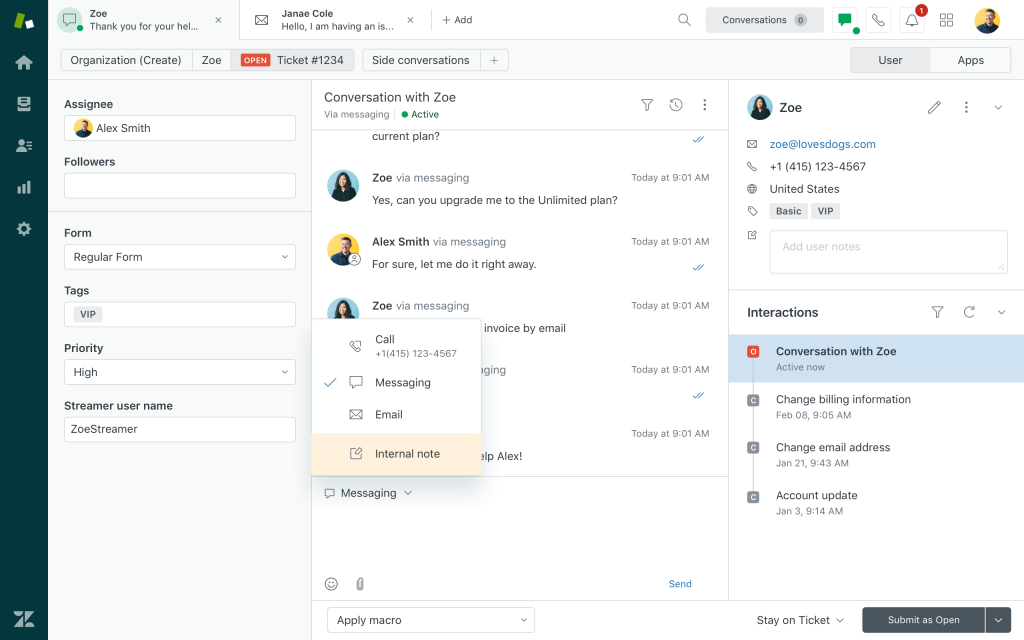
The AI triages incoming tickets, suggests relevant articles, and routes complex cases based on detected intent without manual intervention. Enterprise-grade compliance and security are baked in, which matters for teams in regulated industries. Scaling to thousands of tickets per month is where Zendesk AI performs most reliably.
My honest take is that Zendesk AI earns its place only when your team is already deep in the Zendesk ecosystem. Outside of that context, the infrastructure investment is hard to justify for what you get. AI features also add meaningful cost on top of base plan pricing, which catches teams by surprise.
Pros:
- Tight integration with Zendesk tickets, macros, and workflows
- AI-powered triage and intent detection out of the box
- Omnichannel routing across email, chat, and social through one AI layer
- Strong compliance and enterprise security posture
- Scales well for teams handling thousands of tickets monthly
Cons:
- Requires existing Zendesk infrastructure to get full value
- AI features add meaningful cost on top of base plan pricing
User Rating: 4.3/5 (G2)
Pricing: Suite Team starts at $55/agent/month. AI features available on higher tiers.
6. Freshdesk Freddy AI – Best for Mid-Market Support and ITSM Teams
Freshdesk’s Freddy AI runs across their customer support and IT service management products, handling auto-resolution of tickets, article suggestions, and proactive response drafts for agents. It reads incoming queries, scans the knowledge base, and surfaces the most relevant resolution, either autonomously or as a draft for agent review. Multilingual support and global deployment make it a fit for distributed teams.
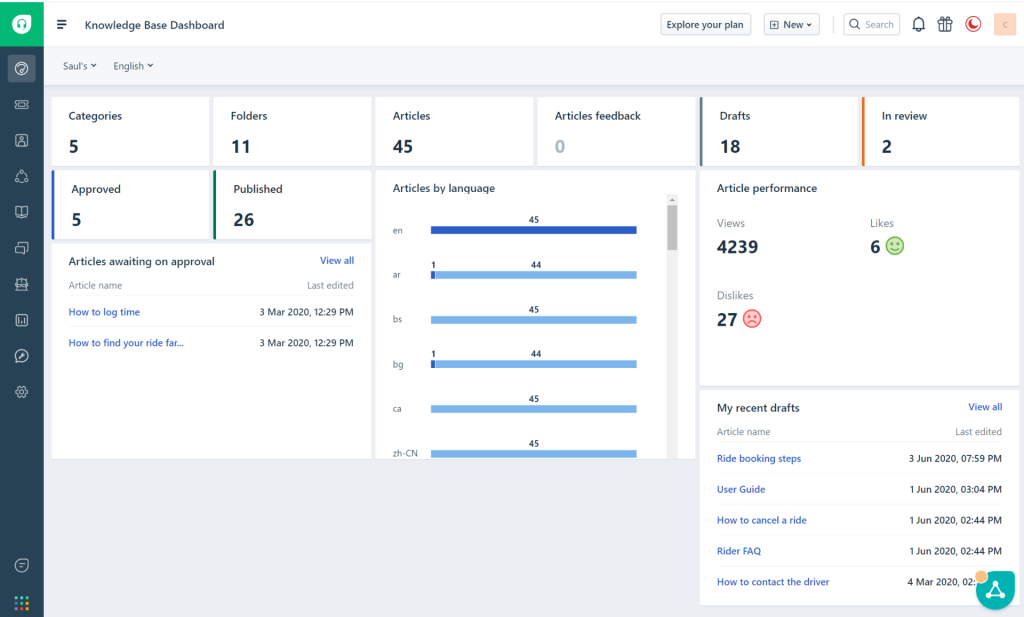
Freddy is most compelling for teams managing both external customer support and internal IT helpdesk under one platform. Instead of running separate tools for each use case, Freddy provides a unified AI layer that reduces tool sprawl and reporting overhead. Solid analytics track AI resolution rates across both functions.
The limitation worth flagging is inconsistent AI quality on complex or unusual queries. If your support interactions tend to be nuanced or technical, Freddy can fall short on edge cases. Full AI capabilities also require higher-tier plans, so the entry price understates your actual cost to get full value.
Pros:
- AI across support, ITSM, and sales products under one platform
- Auto-resolution for common support scenarios without agent involvement
- Multilingual support and global deployment for distributed teams
- Solid reporting with AI resolution rate tracking across functions
- Unified AI layer reduces tool sprawl for teams running both helpdesk and ITSM
Cons:
- AI quality inconsistent on unusual or complex query types
- Full AI capabilities require higher-tier plans
User Rating: 4.4/5 (G2)
Pricing: Growth plan from $15/agent/month. Freddy AI features from $29/agent/month.
7. Drift – Best for B2B Pipeline Acceleration
Drift positions its AI agent as a revenue tool first, not a support tool. The agent identifies high-intent visitors, engages them with personalized conversations, qualifies them against your ICP criteria, and books meetings without a rep involved. Real-time buying signals and intent data let the AI prioritize accounts most likely to convert.
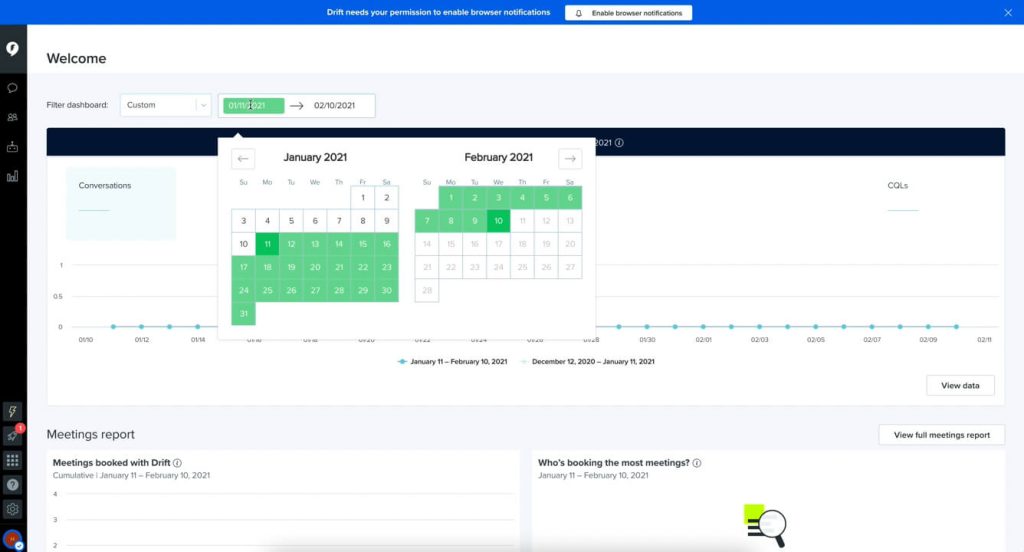
For B2B companies with long sales cycles, Drift’s account-based features treat a visitor differently based on the company they are from. It serves tailored messages to target accounts while routing everyone else through a standard qualification flow. Strong Salesforce and HubSpot integrations push qualified prospects directly into your pipeline.
The honest caveat is price and configuration time. Drift starts around $2,500/month for most plans, and it requires significant setup before the AI performs well for your specific ICP. If your primary need is support deflection rather than pipeline acceleration, there are better-value tools on this list.
Pros:
- Revenue-focused AI with account-based targeting for high-value prospects
- Meeting booking built directly into the conversation flow
- Strong Salesforce and HubSpot integration for pipeline sync
- Real-time buying signals and intent data to prioritize outreach
- 60+ pre-built conversation playbooks to accelerate deployment
Cons:
- Primarily a sales tool; support use cases are secondary
- Requires significant configuration to perform well
User Rating: 4.4/5 (G2)
Pricing: Custom pricing on request. Starts around $2,500/month for most plans.
8. Ada – Best for Enterprise-Scale Automation
Ada is built for large organizations that want to automate the majority of customer interactions without human involvement. Its no-code builder lets non-technical teams create and adjust conversation flows without IT support. The platform maintains consistency and accuracy across languages and channels even as interaction volume spikes.
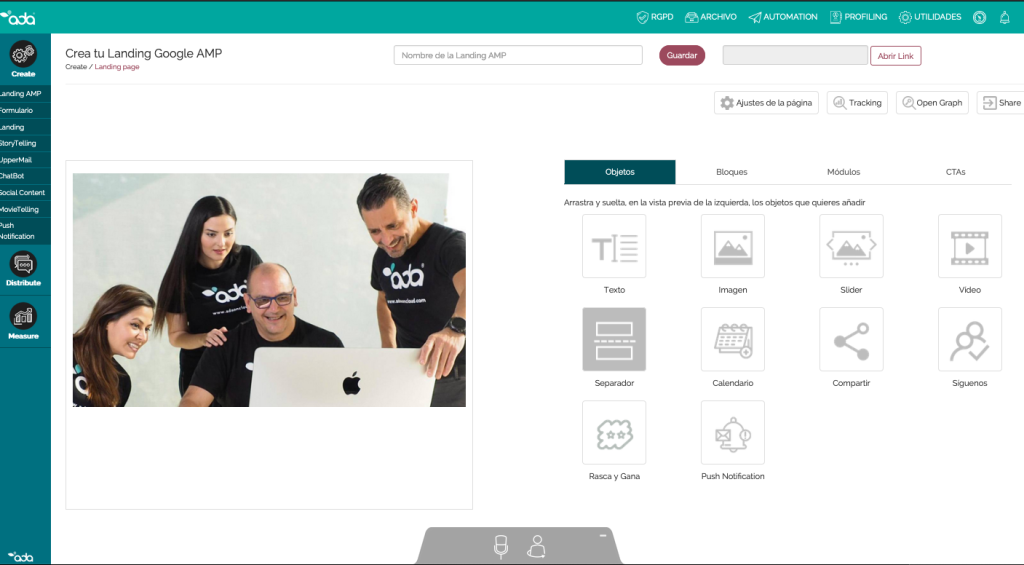
Support for 50+ languages and robust analytics with containment rate and CSAT tracking make Ada a serious option for global brands. The platform’s Reasoning Engine handles complex, multi-step conversations that would stump simpler bots, improving over time as it processes more real interactions. Enterprise-grade security and compliance are built in.
Where teams struggle with Ada is the implementation phase. Getting it to perform well at enterprise scale takes time and resources, and smaller operations often find the ROI does not materialize at their volume. Custom pricing also means you are going into a sales conversation without a clear number to benchmark against.
Pros:
- Built for high-volume, enterprise-scale automation without performance degradation
- No-code flow builder accessible to non-technical teams
- Multilingual support across 50+ languages for global deployments
- Reasoning Engine handles complex, multi-step conversations that stump simpler bots
- Robust analytics with containment rate and CSAT tracking
Cons:
- Enterprise pricing makes it inaccessible for smaller teams
- Implementation requires significant time investment upfront
User Rating: 4.6/5 (G2)
Pricing: Custom pricing on request.
9. HubSpot Chatbot – Best for Conversational Lead Generation
HubSpot’s chatbot integrates natively with HubSpot CRM, making lead qualification, meeting scheduling, and follow-up automation seamless for teams already in the HubSpot ecosystem. Captured visitor data flows directly into your CRM pipeline without manual entry. Reporting lets you track chatbot performance against conversion goals from the same dashboard you use for everything else.
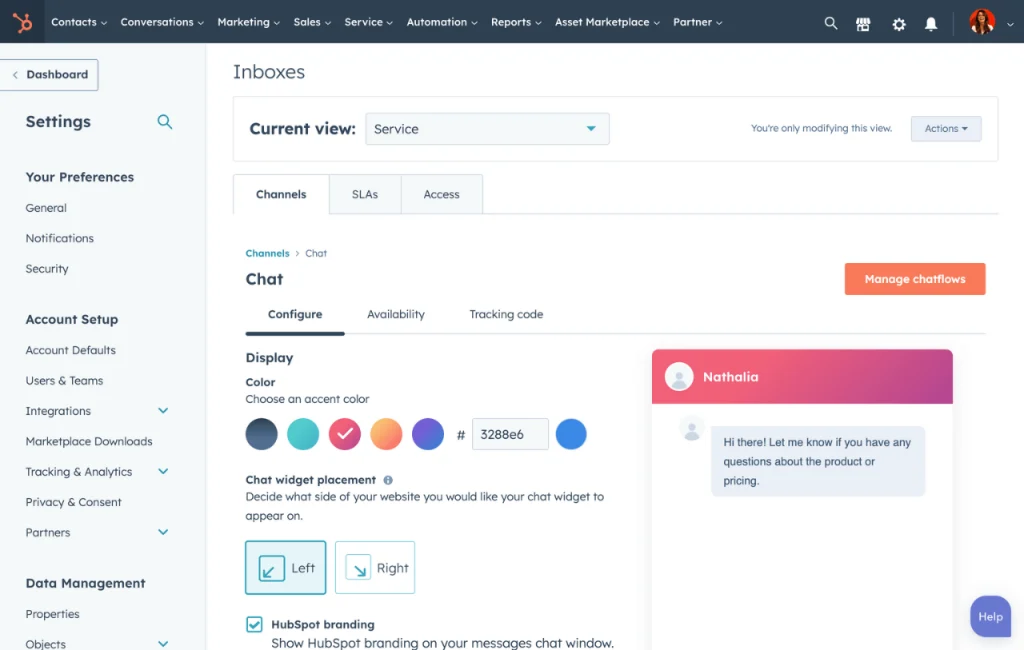
Customizable workflows let you tailor chat responses to different visitor segments, and ticket creation converts unresolved conversations into support cases automatically. The interface has a minimal learning curve for anyone already familiar with HubSpot’s product suite. It is a natural fit for inbound-focused sales teams that want everything running inside one platform.
The limitation is clear: teams not already on HubSpot will find limited reason to choose it over more flexible standalone options. AI capabilities are also more limited compared to dedicated chatbot platforms, so if advanced conversational AI is a priority, you will hit a ceiling quickly.
Pros:
- Native HubSpot CRM integration; all lead data flows automatically without manual entry
- Meeting scheduling and ticket creation built in
- Customizable workflows for tailored chat responses by visitor segment
- Clean interface with minimal learning curve for HubSpot users
- Unified reporting ties chatbot performance to pipeline and conversion goals
Cons:
- Full value requires existing HubSpot investment
- AI capabilities are more limited compared to dedicated chatbot platforms
User Rating: 4.4/5 (G2)
Pricing: Starts at $15/seat/month.
10. Crisp – Best for Growing Teams That Want Engaging Conversational Flows
Crisp uses AI to enable personalized, automated conversations that qualify leads, schedule meetings, and handle FAQs with a conversational quality that feels less robotic than many tools in this tier. The shared inbox centralizes all conversations from one platform, reducing the switching between channels that burns agent time. It is competitively priced relative to the feature depth you get.
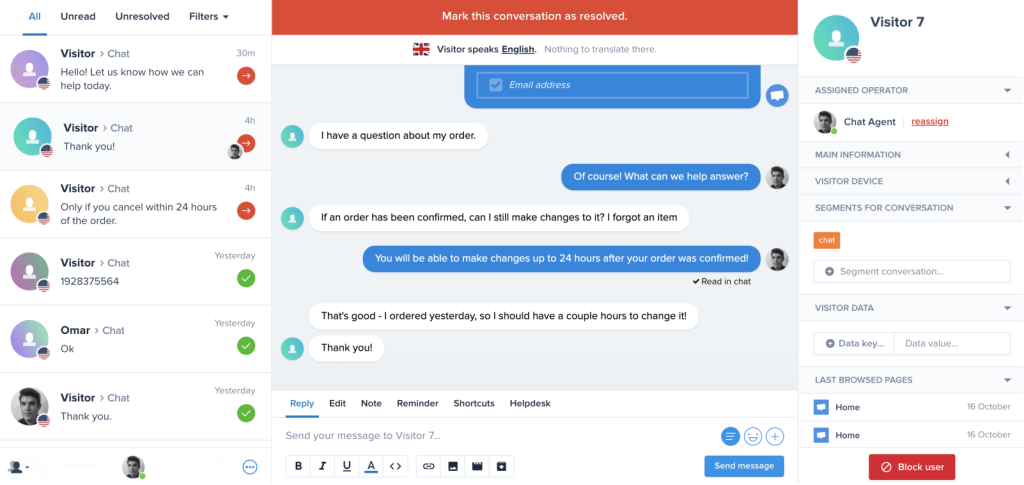
The analytics dashboard tracks key performance metrics and the AI-powered product recommendation engine gives sales teams a useful upsell and cross-sell assist. Crisp also supports a multisite setup, making it useful for teams managing more than one web property. Customer support response times are generally well-reviewed on G2.
The main constraint is pre-defined workflows. Businesses with complex or evolving sales motions will find the rigidity limits how far they can push the platform. Crisp is a solid choice for growing teams, but enterprises or multi-brand operations will likely need something more configurable.
Pros:
- Shared inbox to manage all conversations centrally across channels
- AI-powered product recommendations to support upsell and cross-sell
- Analytics dashboard for key performance tracking
- Multisite support for teams managing more than one web property
- Affordable entry price relative to feature depth
Cons:
- Pre-defined workflows limit flexibility for non-standard sales flows
- Less suited for enterprise-scale or multi-brand deployments
User Rating: 4.5/5 (G2)
Pricing: From $95/month.
11. Chatfuel – Best for Facebook Messenger Bot Automation
Chatfuel is the go-to for businesses building Facebook Messenger bots quickly and without technical resources. Its no-code platform simplifies bot creation, and native integrations with Shopify and Google Sheets make it easy to manage sales workflows and sync data without custom development. AI-powered responses personalize interactions at scale across your Messenger audience.
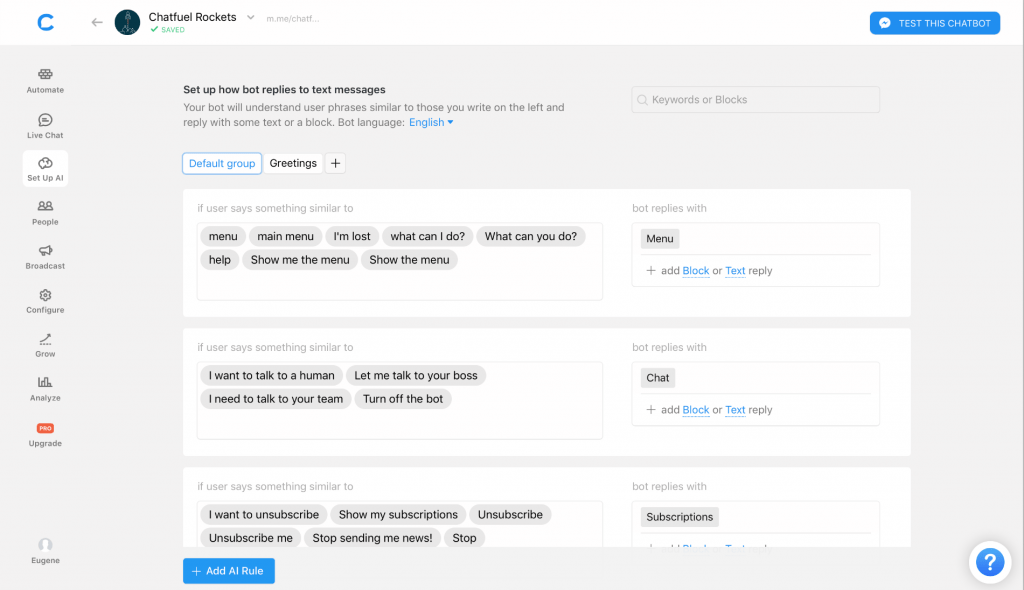
Broadcasting tools let you send promotions and product updates directly to subscribers, which gives eCommerce brands a direct-to-customer channel outside of email. Multi-language support broadens your reach for global Messenger audiences. The interface is beginner-friendly, and most teams can have a working bot live within a few hours.
The channel limitation is worth flagging upfront. Chatfuel’s strength is Messenger, and if you need omnichannel coverage across your website, WhatsApp, and Instagram in a unified dashboard, this is not the right tool. It is best suited for brands whose customers are already concentrated on Facebook.
Pros:
- No-code bot builder accessible to non-technical teams with zero coding required
- Broadcasting tools to send promotions and updates to subscribers at scale
- Multi-language support for global Messenger audiences
- Shopify and Google Sheets integration for sales workflow management
- Beginner-friendly interface with most bots live within a few hours
Cons:
- Primary focus on Facebook Messenger limits multi-channel capability
- Less suited for website-first or omnichannel support strategies
User Rating: 4.3/5 (Capterra)
Pricing: From $12.04/month.
12. Kommunicate – Best for Mobile-First In-App AI Support
Kommunicate specializes in AI-powered support for mobile-first products. Its agent SDK integrates directly into iOS and Android apps, letting businesses deploy conversational AI without redirecting users to a separate support channel or breaking the in-app experience. Human handoff is built in, with full conversation context transferred to the agent automatically.
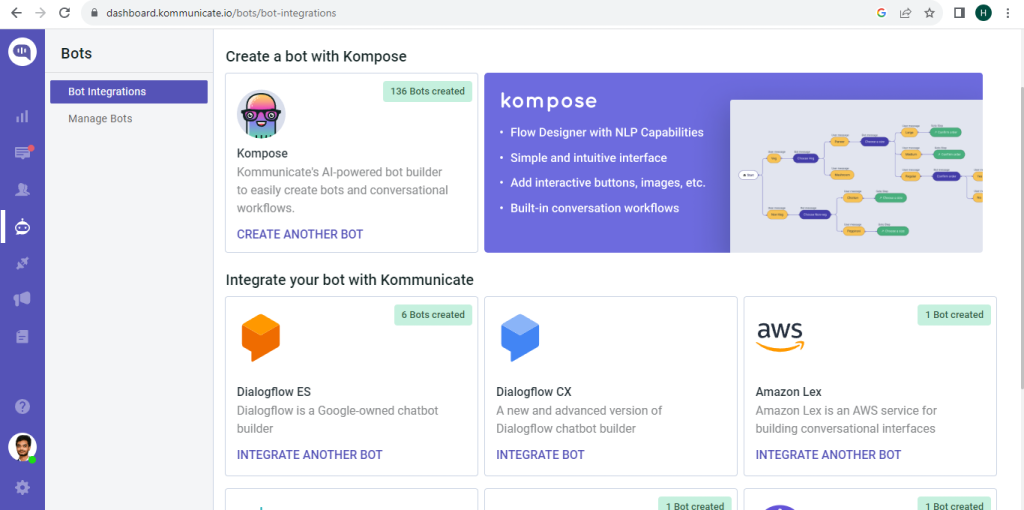
Teams connect Kommunicate to Dialogflow, Amazon Lex, or IBM Watson for natural language processing, then build the conversation interface on top. The result is a branded in-app agent that handles FAQs, collects feedback, and escalates issues without the customer ever leaving the product. Multi-language support and rich media messaging (cards, buttons, images) are available across integrations.
The setup requirement worth knowing upfront is that you need to bring your own NLP provider. This is not a self-contained plug-and-play solution like most other tools on this list. Analytics are also thinner than standalone platforms, so teams that rely heavily on reporting may find the data views lacking.
Pros:
- Native iOS and Android SDK for in-app AI deployment without breaking user experience
- Connects to Dialogflow, Amazon Lex, and IBM Watson for flexible NLP options
- Human handoff with full conversation context preserved automatically
- Multi-language support for global mobile audiences
- Rich media messaging (cards, buttons, images) available across integrations
Cons:
- Requires a separate NLP provider, not a self-contained setup
- Analytics thinner than standalone platforms
User Rating: 4.5/5 (G2)
Pricing: Starter plan from $40/month. Growth from $100/month.
How I Evaluated These AI Sales Chatbot Tools
There are hundreds of AI chatbot platforms out there. I skipped the marketing copy and focused on what actually matters. Here is the framework I used.
- User Reviews and Ratings: I went straight to G2, Capterra, and Gartner for verified feedback, focusing on recurring complaints and what teams actually praised after six-plus months of real use, not launch honeymoon reviews.
- Core Features and Functionality: I tested each tool hands-on, specifically looking at AI answer quality, training speed, CRM integration depth, conversation handoff quality, and whether reporting gave actionable data or just looked impressive in screenshots.
- Ease of Use: One simple question: can a non-technical team member get this running without a training session or a call with sales? The answer varied dramatically across tools.
- Customer Support Quality: I tracked how each vendor showed up during setup, when things broke, and whether ongoing support felt like a partnership or a ticket queue.
- Value for Money: I compared pricing against actual feature depth. A tool that does three things well is not a bargain for a team of ten.
- Personal Experience: I used each platform myself, cross-checked with peers who run similar operations, and factored in input from people who live inside these tools daily.
What Are My Top 3 Picks for the Best AI Sales Chatbots?
After testing all 12 AI sales bots, three kept pulling ahead. If you need a starting point, here is where I would send most teams.
1. ProProfs Chat
ProProfs Chat gets an AI sales agent live in under a day, no developer required. It trains on your website URL or uploaded files, handles lead capture and FAQ deflection out of the box, and includes sentiment analysis plus churn risk scoring that most competitors reserve for enterprise tiers. The Forever Free plan makes it risk-free to test.
2. Intercom
Intercom’s Fin AI handles multi-turn conversations with more contextual depth than most tools in this category, making it a strong fit for SaaS companies with rich help centers. Resolution tracking is detailed enough to show exactly what the agent is earning its keep on. It is a premium choice, but the reporting depth justifies the cost at scale.
3. Tidio
Tidio pairs AI-powered support with native eCommerce integrations in a single platform. The Lyro AI handles FAQ queries reliably, Shopify and WooCommerce connections work without custom setup, and the Flows builder covers cart abandonment without needing a developer. For online stores that want sales and support covered in one tool, Tidio is the practical choice.
FREE. All Features. FOREVER!
Try our Forever FREE account with all premium features!
Put Your Sales on Autopilot With AI Sales Chatbots
The best AI chatbots for sales are not just FAQ deflectors. They qualify leads, detect frustration before it becomes churn, complete tasks mid-conversation, and hand off to humans with the full story already told.
To choose the right one: start with your primary goal: support deflection, lead capture, or both. Prioritize CRM and help desk integrations from day one. Track unresolved query rates weekly to improve AI performance over time. And avoid paying enterprise pricing until you’ve validated the use case at your actual volume.
If you want a low-risk starting point, ProProfs Chat’s Forever Free plan includes an AI agent, live chat, sentiment analysis, and lead capture, no credit card required. Most teams are live within a day.
That is the fastest path from “we should try AI support” to “our pipeline grew, and our ticket volume dropped.”
Start your free ProProfs Chat account today and see the AI agent in action.
Frequently Asked Questions
Are AI sales chatbots easy to set up for small businesses?
Yes. Most modern platforms require no coding and offer ready-made templates. A non-technical team member can have a trained, deployed bot live within a day using tools like ProProfs Chat.
How do AI sales chatbots improve lead conversion rates?
They engage visitors instantly, ask qualifying questions, capture contact information, and route high-intent leads to your CRM or sales team without manual intervention. Removing response delay alone is a measurable conversion lift.
Will an AI sales chatbot replace my human sales team?
No. AI handles high-volume tier-1 interactions so your team focuses on complex deals that require judgment and relationship. Most teams see faster response times and higher CSAT after deployment, not headcount reductions.
What is the difference between AI chatbots and live chat?
Live chat connects visitors to a human agent in real time. AI chatbots handle conversations automatically using trained data, available 24/7 without staffing. Most platforms now offer both in one product, with the bot handling off-hours and the human stepping in when needed.
Can AI chatbots handle complex sales questions or only basic FAQs?
Modern AI chatbots trained on your product documentation, help articles, and CRM data can handle nuanced pre-sales questions accurately. Simple FAQ bots have limits, but action-based AI agents like those in ProProfs Chat can complete multi-step tasks mid-conversation.
What integrations should an AI sales chatbot support?
At minimum: your CRM (Salesforce, HubSpot, or Zoho), your help desk or ticketing system, and your website platform. eCommerce teams should also prioritize Shopify, WooCommerce, or Magento integrations for order data access.
Can I customize an AI sales chatbot to match my brand?
Yes. Most platforms let you set a custom name, avatar, tone guidelines, and welcome messages. ProProfs Chat supports full white-labeling ,so no third-party branding is visible to your customers.
FREE. All Features. FOREVER!
Try our Forever FREE account with all premium features!

 We'd love your feedback!
What did you like & how can we make it even better?

 Thanks for your feedback!
 Ask Your Question
Have a question? Get expert help to make your decision easier.